SENSEI Framework
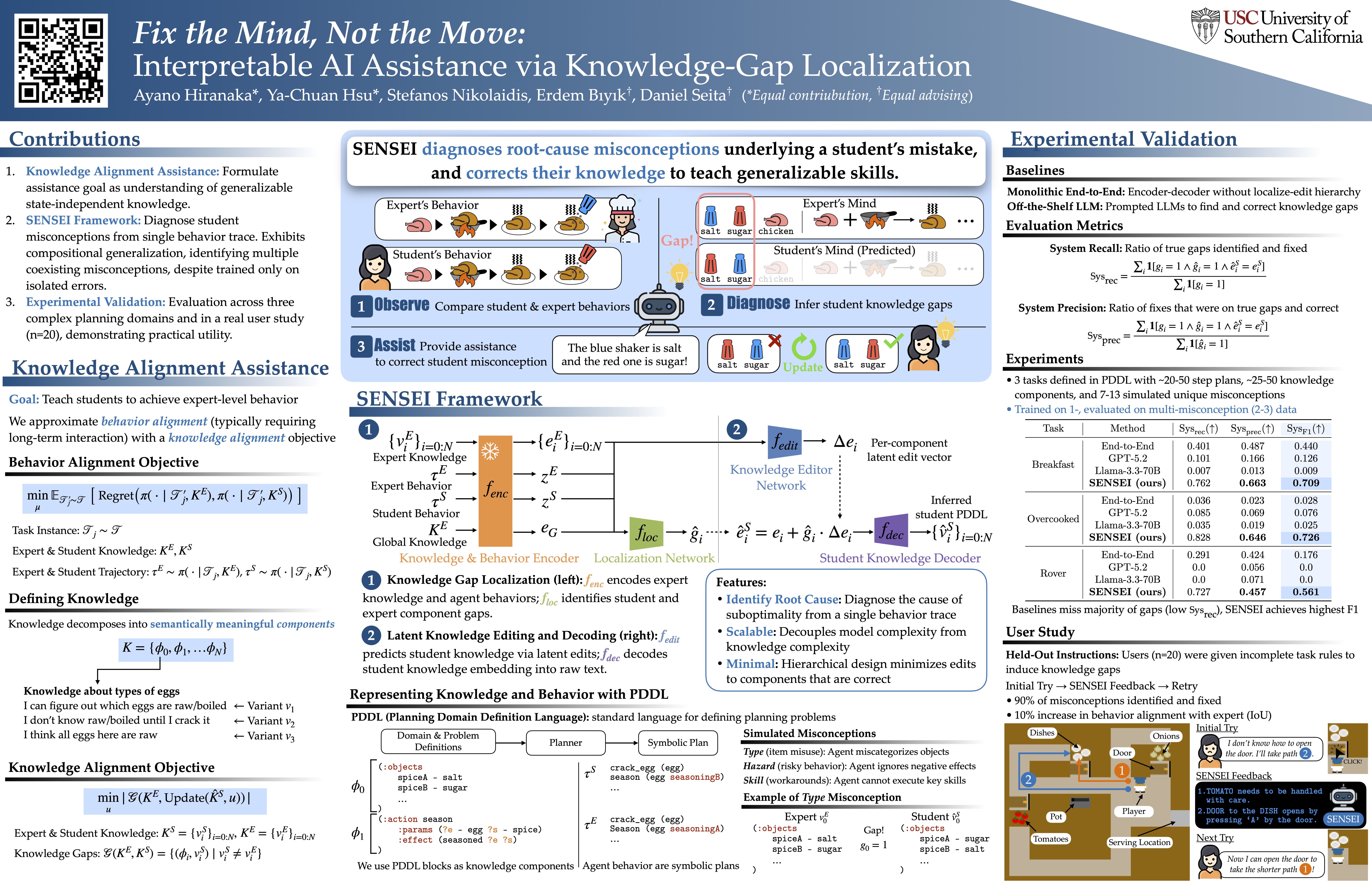
SENSEI diagnoses student misconceptions through the following steps:
Knowledge representation: Expert knowledge \(K^E\) in the form of human-interpretable text is decomposed into \(N\) knowledge components \(\{v_i^E\}_{i=0:N}\).
Knowledge and behavior encoding: Expert knowledge, expert behavior (\(\tau^E\)), and student behavior (\(\tau^S\)) are embedded with a frozen text encoder (\(f_{enc}\)).
Knowledge gap localization: A trainable gap localization network (\(f_{loc}\)) takes the embeddings as input, and predicts a binary label (\(\hat{g}_i\)) on whether the student has a misconception in each knowledge component \(i\).
Latent knowledge editing: A trainable knowledge editor network (\(f_{edit}\)) takes the embeddings as input, and outputs a latent edit vector (\(\Delta e_i\)). The predicted student knowledge component embedding is \(\hat{e}^S_i = e_i + \hat{g}_i \cdot \Delta e_i\).
Student knowledge decoding: \(\hat{e}^S_i\) is decoded back into human-interpretable text via a finetuned text decoder model \(f_{dec}\).
Simulation Results
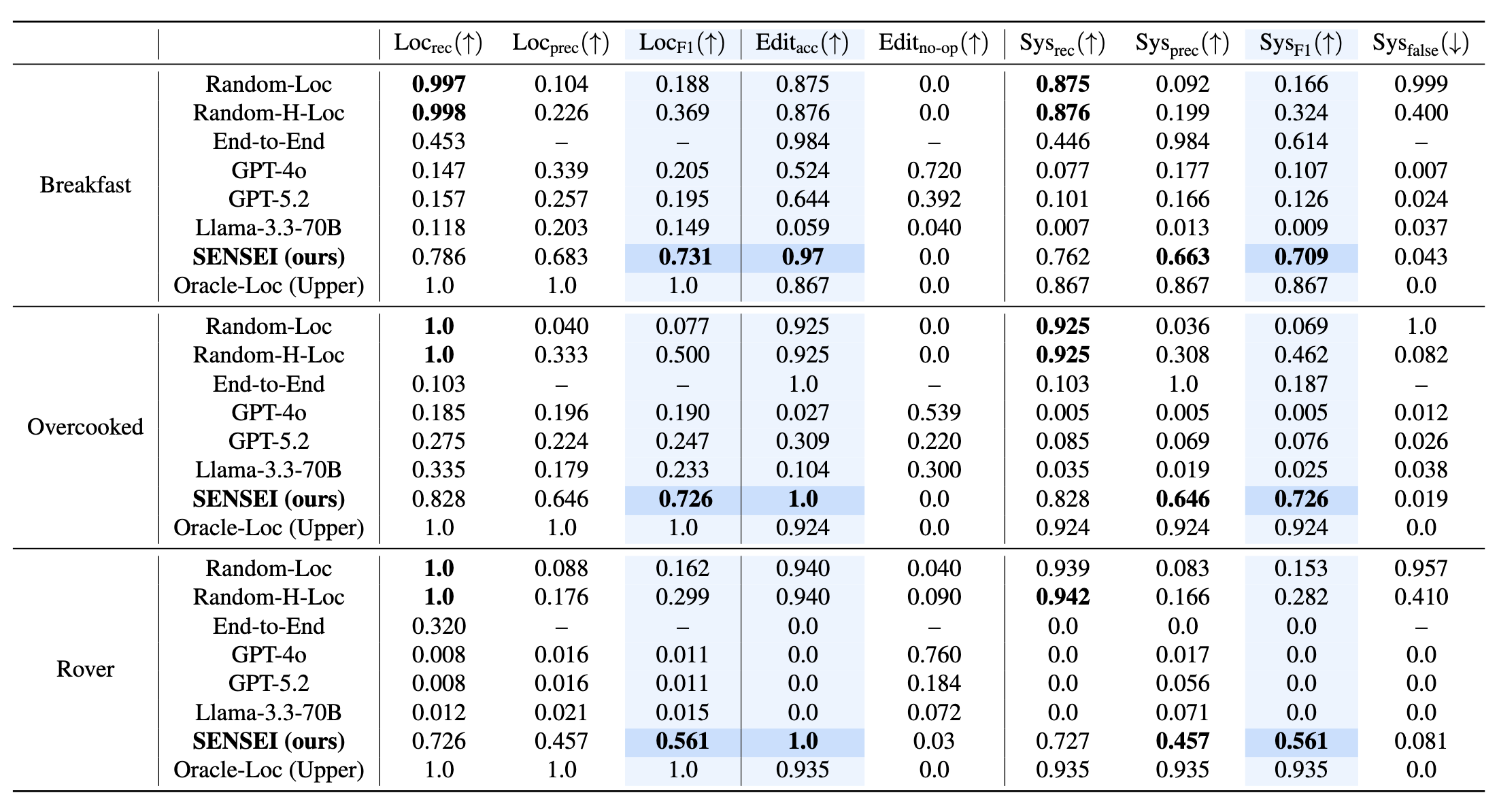
We evaluate SENSEI on 3 simulated tasks (Brekafast, Overcooked, and Rover). For each task, SENSEI is trained with simulated students with 1 misconception, and evaluted on students with 2-3 misconceptions co-existing.
Random baselines make gap localizations randomly, End-to-End baseline directly predicts student knowledge without the localize-then-edit hierarchy, and LLM baselines prompt off-the-shelf LLMs to predict student knowledge. Oracle-Loc uses ground truth gap localization labels.
SENSEI achieves highest System F1 scores for all tasks.
User Study Results
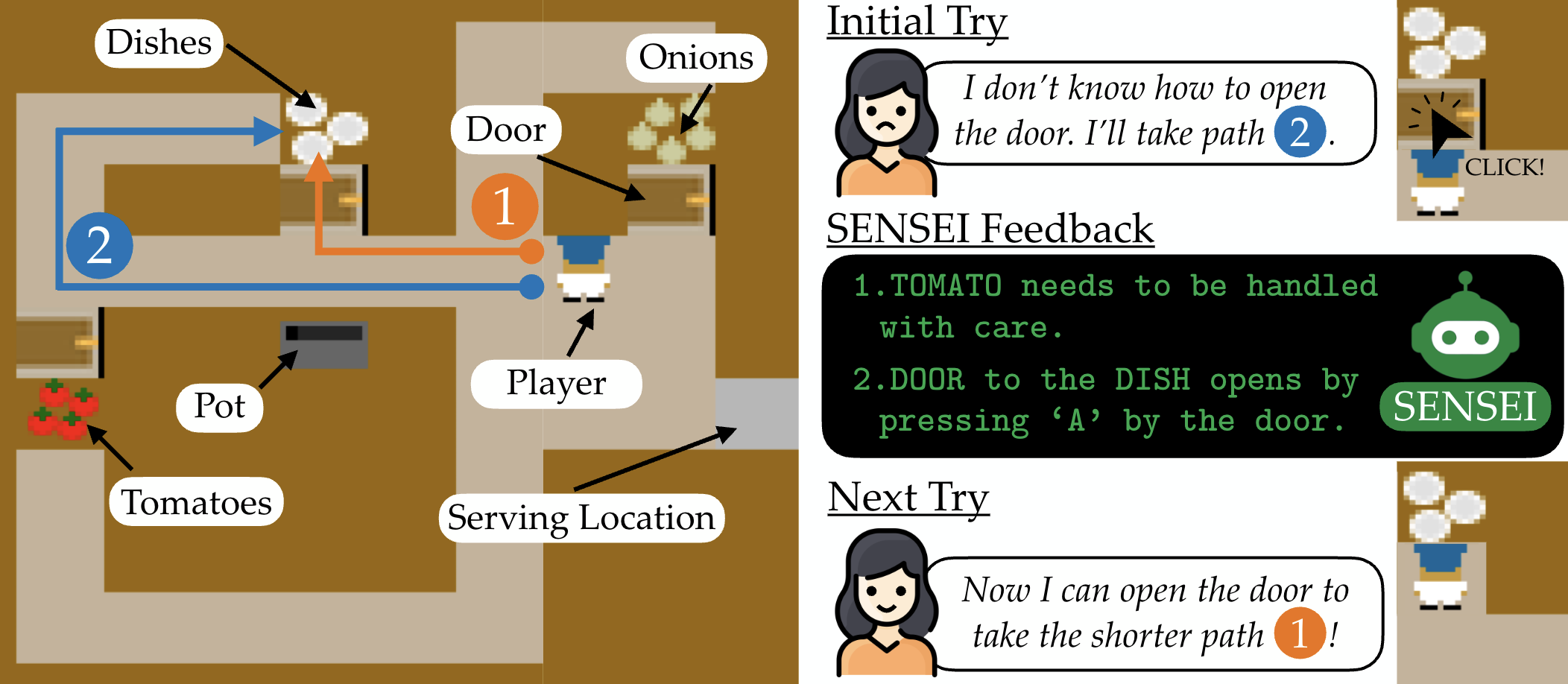
We train SENSEI on the simulated Overcooked task, and test its diagnosis capabilities on real users. Across 20 subjects, SENSEI corrected knowledge gaps with \(\text{Sys}_\text{rec}=0.895\) and \(\text{Sys}_\text{prec}=0.555\). IoU alignment scores measuring similairty between student and expert plans increased from 0.736 to 0.844 (10.8% increase).